Your Furnace Sits Idle for Ten Months, Then Houston Asks It to Work
A furnace that hasn't run since February gets asked to fire up perfectly on the coldest night of the year, with zero warm-up. That's a hard way to find out something's wrong.
October 21, 2026 · 3 min read
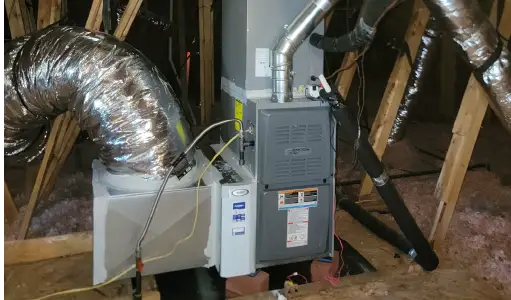
A furnace in Cypress works a strange schedule compared to almost anywhere colder. It might run for six or eight weeks total across an entire year, then sit shut off in a hot, dusty attic for the other ten months. That long idle stretch, not old age, is the reason so many furnace calls in this area land on the same night: the first real cold front of the season.
What ten months of silence does to a furnace
The igniter or pilot assembly is a small, exposed component that spends most of the year doing nothing while attic dust settles on it. Dust on a hot surface igniter changes how it heats, and a unit that lit fine last February can fail to light at all in November. Insects and small animals find their way into flue pipes and combustion air intakes over a Texas summer, because nothing is moving air through them to discourage it. A blower motor that's sat still for months can have more resistance starting up than one running weekly.
Thermostat batteries die on their own schedule, not on a heating schedule, so a thermostat that's been quietly running low all summer picks the worst possible night to finally lose contact with the furnace. None of this is a defect in the equipment. It's what happens to any mechanical system that goes from complete rest straight to full demand with no warm-up period in between.
The flue problem that's specific to attic furnaces
Most furnaces in this part of Harris County sit up in the attic rather than in a basement or a closet, next to the AC air handler they share ductwork with. That attic location creates its own summer problem: the flue pipe and the combustion air intake are two open paths to the outside that nothing has moved air through in months. Wasps and mud daubers build nests in vent terminations over a Texas summer. Dust settles inside the flue itself. Neither one announces itself until the furnace tries to fire, draw air through a partially blocked intake, and vent exhaust through a partially blocked flue, all at once, on the first cold night of the year.
That's exactly why the safety controls on a furnace exist, and why testing them is part of a real inspection rather than an afterthought. A blocked flue paired with a safety control that's also worn or miscalibrated is a genuinely dangerous combination, not just an inconvenient one.
The signs, if you catch them before the cold front
A furnace that's about to have a bad first night usually gives some warning if anyone runs it early. Short cycling, where it fires and shuts off again quickly, points to a limit switch or airflow problem. Weak or uneven heat, where one room never gets warm while another overheats, often points to ductwork rather than the furnace itself. Unusual noises on startup, a bang, a persistent rattle, or a screech from the blower, are worth listening for. And a cracked heat exchanger is a safety issue, not just a comfort one, which is why CO and safety-control testing is part of any real furnace inspection.
- Ignition or pilot failures, or a longer delay before it lights
- Short cycling, firing and shutting off again quickly
- A blower motor that sounds strained or louder than before
- Uneven heat between rooms
- Unusual banging, rattling, or screeching on startup
- A thermostat that seems unresponsive or reads oddly
Why early fall, not the cold snap itself, is the right time
Furnace maintenance covers burner cleaning, gas pressure adjustment, safety control and limit switch testing, a heat exchanger inspection for cracks or corrosion, electrical connections, thermostat calibration, and a check of the flue and ventilation. Doing that in September or early October means any of the issues above get found and fixed while the weather is still mild, not at nine at night when the first cold front of the year has just rolled through Harris County and every other furnace in Cypress is trying to light for the first time in months. If yours already didn't light and it's cold in the house right now, our emergency line runs around the clock and we'll get eyes on it.
American Comfort Experts, (281) 256-3433
Call (281) 256-3433More articles
Why Cypress Air Conditioners Fail in July, and What April Already Told You
The unit that quits on the hottest afternoon of the year almost never quits without warning. It just warns you in April, when it's easy to ignore.
Why a Heat Pump in Houston Wants Two Visits a Year, Not One
One machine, two jobs, twice the moving parts that can go wrong in each direction, which is the whole reason heat pump service runs on a spring-and-fall schedule instead of once a year.