Why Cypress Air Conditioners Fail in July, and What April Already Told You
The unit that quits on the hottest afternoon of the year almost never quits without warning. It just warns you in April, when it's easy to ignore.
October 21, 2026 · 4 min read
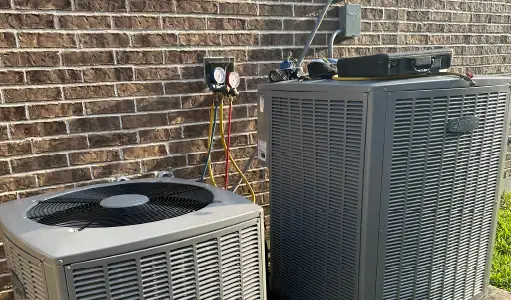
By the time an air conditioner actually stops cooling in Cypress, it has usually been failing for months. Harris County's cooling season runs close to nine months a year, and a system that carries that kind of duty cycle wears out its weakest part first, quietly, long before the compressor gives up for good. The part fails in spring. The house just doesn't get hot enough yet for anyone to notice.
The part that goes first: the run capacitor
Inside the outdoor unit is a cylinder about the size of a can of soda, bolted to a bracket next to the compressor. That's the run capacitor, and its job is to give the compressor and the outdoor fan motor the jolt of current they need to start turning. Capacitors lose capacitance gradually as they age, and heat speeds the process up. A capacitor rated for a certain range can drift low enough that the compressor hesitates before it catches, or the outdoor fan spins slower than it should.
In March or April, a weak capacitor might show up as a system that takes an extra second or two to kick on, or a breaker that trips once and resets fine. It's easy to write off. By July, when the compressor has to start against a much higher head pressure because the outdoor air is 30 degrees hotter, that same weak capacitor is the difference between a system that runs and one that hums and does nothing.
Refrigerant doesn't wear out, but the lines and the drain do
A sealed refrigerant system doesn't consume refrigerant the way a car burns gas. If a system is low on charge, refrigerant is leaving somewhere, usually a small joint or a coil pinhole. Low charge shows up first as ice forming on the copper suction line, which people often notice in spring when the system is running but the house feels a little muggier than expected. By midsummer that same slow leak can be enough charge loss that the coil freezes solid and the system stops moving any cool air at all.
The condensate drain has its own Gulf Coast problem. Humidity this heavy means a lot of water comes off the evaporator coil, and that water runs through a PVC line that grows algae in the dark and the wet. A partially clogged line backs up slowly over weeks. A fully clogged one trips the float switch and shuts the whole system down, usually on a weekend, usually when it's hot.
- Warm air coming from the vents instead of cold
- Ice visible on the outdoor unit's copper lines
- Water pooling around the indoor air handler
- A breaker that trips more than once
- The system short cycling, running for a minute or two and stopping
- New rattling, clicking, or grinding sounds from either unit
The cheapest fix in the whole list, and the one everyone skips
A one-inch pleated filter looks like a small thing, but it's the only part of the system a homeowner touches directly, and it's usually the last thing checked when something goes wrong. Cypress runs through a heavy pollen season in spring, right on top of whatever construction dust is drifting through a growing area, and a filter that would last two months somewhere else can load up in three or four weeks here. A restricted filter starves the evaporator coil of the warm return air it needs to stay above freezing, and a coil that drops below freezing starts icing over from the inside, which looks exactly like a refrigerant problem from the outside even when the charge is fine.
That's the part that makes spring symptoms so easy to misread. A slightly weak capacitor, a slightly low charge, and a slightly restricted filter each look minor on their own. Stacked together on a July afternoon, with the compressor already working against outdoor air well past 95 degrees, they add up to a system that goes from struggling to stopped in the space of a single hot week.
Why it all lands in July specifically
A Texas attic can sit well over 130 degrees on a sunny July afternoon, and most Cypress homes push return air through ductwork that runs right through that attic. That heat load pushes every part of the system harder, longer, more often, at the exact time of year when a marginal capacitor, a slow leak, or a half-clogged drain finally crosses the line from working to not working. None of those failures started in July. July is just where the math stops working out.
The ACE Precision Tune-up checks coil condition, refrigerant charge, electrical connections, capacitor and contactor wear, the condensate drain, thermostat calibration, and airflow, which covers every item on that list above before summer puts real weight on it. If your system already skipped that step this year and it's showing you one of the signs above, our line is staffed 24/7 and we'll tell you honestly whether it's a repair or something bigger before any work starts.
American Comfort Experts, (281) 256-3433
Call (281) 256-3433More articles
Your Furnace Sits Idle for Ten Months, Then Houston Asks It to Work
A furnace that hasn't run since February gets asked to fire up perfectly on the coldest night of the year, with zero warm-up. That's a hard way to find out something's wrong.
Why a Heat Pump in Houston Wants Two Visits a Year, Not One
One machine, two jobs, twice the moving parts that can go wrong in each direction, which is the whole reason heat pump service runs on a spring-and-fall schedule instead of once a year.